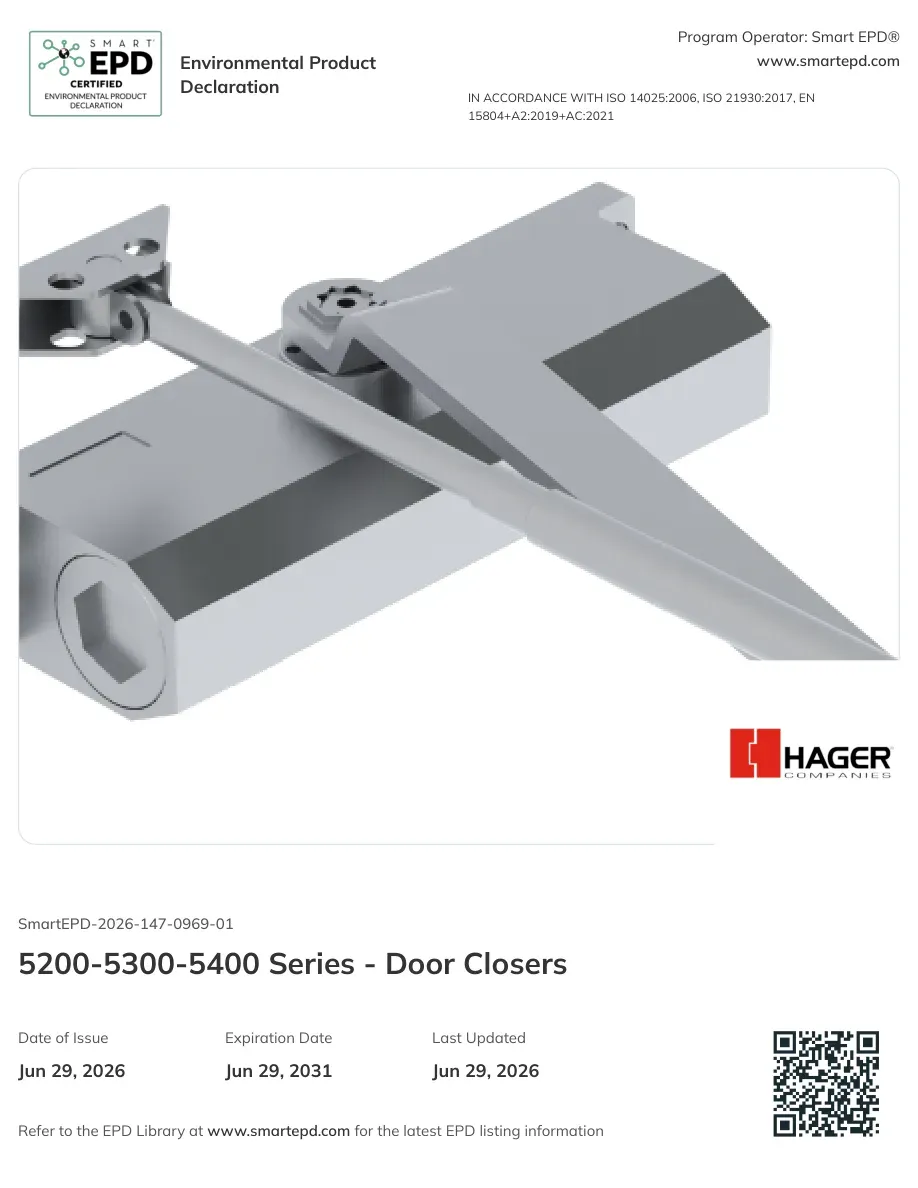
SmartEPD-2026-147-0969-01Date of IssueJun 29, 2026Expiration DateJun 29, 2031Last UpdatedJun 29, 2026Refer to the EPD Library at www.smartepd.com for the latest EPD listing information5200-5300-5400 Series - Door ClosersEnvironmental ProductDeclarationProgram Operator: Smart EPD®www.smartepd.comIN ACCORDANCE WITH ISO 14025:2006, ISO 21930:2017, EN15804+A2:2019+AC:2021
General InformationHager Companies139 Victor St, St. Louis, MO 63104, USA+1 800-325-9995marketing@hagerco.comhagerco.comProduct Name:5200-5300-5400 Series - Door ClosersDeclared Unit:1 piece per standard door leafDeclaration Number:SmartEPD-2026-147-0969-01Date of Issue:June 29, 2026Expiration:June 29, 2031Last updated:June 29, 2026EPD Scope:Cradle to gate with optionsA1 - A3, A4, A5, C1 - C4Market(s) of Applicability:North AmericaGeneral Organization InformationHager Companies Founded in 1849, St. Louis-based Hager Companies offers more than 6,000 full-line quality door hardware products under one brandname. With 13 product lines including, commercial hinges, residential hinges, Roton® continuous geared hinges, stainless steel continuous hinges, exitdevices, locks, door controls, auxiliary, threshold and weatherstripping, sliding door hardware, electrified hardware, access control products and Euroline, ourEuropean hardware line. Hager focuses on architectural hardware that exceeds today’s building standards that are built to last.Further information can be found at:http://www.hagerco.comLimitations, Liability and OwnershipEnvironmental declarations from different programs (ISO 14025) may not be comparable. Comparison of the environmental performance of products usingEPD information shall be based on the product’s use and impacts at the building level, and therefore EPDs may not be used for comparability purposes whennot considering the whole building life cycle. EPD comparability is only possible when all stages of a life cycle have been considered. However, variations anddeviations are possible. Example of variations: Different LCA software and background LCI datasets may lead to differences results for upstream ordownstream of the life cycle stages declared. The EPD owner has sole ownership, liability, and responsibility for the EPD.Reference StandardsStandard(s):ISO 14025:2006, ISO 21930:2017, EN 15804+A2:2019+AC:2021Core PCR:UL Part A PCR for Building-Related Products and Services v3.2Date of issue: December 12, 2018Sub-category PCR:UL Part B: Builders Hardware EPD Requirements v.2Date of issue: August 19, 20255200-5300-5400 Series - Door ClosersHager CompaniesPage 2 / 12
Valid until: August 19, 2030Sub-category PCR review panel:Contact Smart EPD for more information.General Program Instructions:Smart EPD General Program Instructions v.2.0, March 2025Verification InformationLCA Author/Creator:juan@parqhq.comjuan@parqhq.comEPD Program Operator:Smart EPDinfo@smartepd.comwww.smartepd.com585 Grove St., Ste. 145, Herndon, VA 20170, USAVerification:Independent critical review of the LCA and data, according to ISO 14044 andISO 14071:ExternalArka Panditpandit_arka@outlook.comIndependent external verification of EPD, according to ISO 14025 andreference PCR(s):ExternalArka Panditpandit_arka@outlook.comProduct InformationDeclared Unit:1 piece per standard door leafMass:2.94 kgReference Service Life:25 YearsProduct Specificity:Product AverageProduct SpecificRepresentative Product EPDProduct DescriptionHager Companies emphasizes the importance of high-quality finishing components in building applications. The 5200 Series Closers are specificallydesigned for exterior and interior doors in medium- to heavy-duty settings. These closers feature a durable aluminum alloy body along with a heat-treatedsteel piston and a triple heat-treated steel spindle. They are non-handed, allowing installation on both left- and right-handed doors, and offer adjustablesizing from 1 to 6. This versatility makes them suitable for doors weighing up to 250 lbs. The 5300 Series Closers are engineered for a wide range ofapplications, combining aluminum alloy construction with the reliability expected from Hager Grade 1 products. These closers are designed to meet bothcommercial and institutional requirements, including ADA accessibility standards. Like the 5200 Series, they are adjustable from size 1 through 6 and areappropriate for doors up to 250 lbs. The 5400 Series Closers are ideal for light-duty commercial use. They incorporate a heat-treated steel piston and a tripleheat-treated steel spindle, and are non-handed for flexible installation. Unlike the other series, these closers have fixed spring sizes, with door weightcapacities depending on the selected size: size 2 supports up to 80 lbs, size 3 up to 135 lbs, size 4 up to 175 lbs, and sizes 5–6 up to 200 lbs. Overall, thesedoor closers are designed for reliability and high performance, and are available in multiple configurations to accommodate different arm types and aestheticpreferences. The associated EPD reflects results based on the most commonly sold product configurations.5200-5300-5400 Series - Door ClosersHager CompaniesPage 3 / 12
Further information can be found at:https://www.hagerco.com/products-portal/door-controlsProduct SpecificationsProduct Classification Codes:EC3 - Accessories -> DoorsHardwareMaterial CompositionMaterial/Component CategoryOrigin% MassABSCN3.63AluminumCN23.04Hydraulic FluidCN7.24Nitrile rubberCN0.08SteelCN66.01Packaging MaterialOriginkg MassCorrugated board box0.18Wood pallet0.02Biogenic Carbon Contentkg C per pieceBiogenic carbon content in product0NoneBiogenic carbon content in accompanyingpackaging0.09Hazardous Materials2,2',2''-Hexahydro-1,3,5-triazine-1,3,5-triyl)triethanol (Not specified in SDS)EPD Data SpecificityPrimary Data Year:2025Manufacturing Specificity:Industry AverageManufacturer AverageFacility SpecificAveraging:A weighted average calculated across multiple product models within the 5200-5300-5400 Door Closers Series using sales volumes as weighting factors.5200-5300-5400 Series - Door ClosersHager CompaniesPage 4 / 12
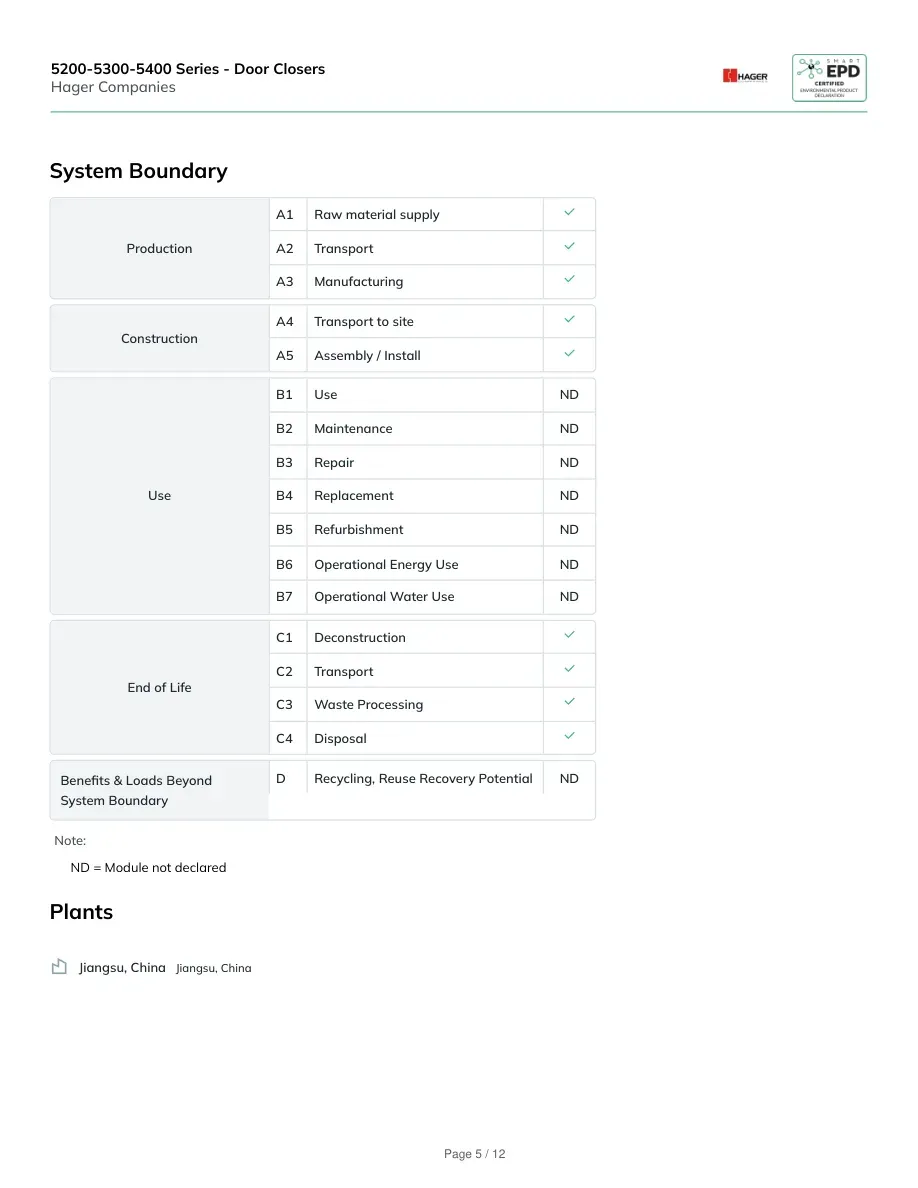
System BoundaryProductionA1Raw material supplyA2TransportA3ManufacturingConstructionA4Transport to siteA5Assembly / InstallUseB1UseNDB2MaintenanceNDB3RepairNDB4ReplacementNDB5RefurbishmentNDB6Operational Energy UseNDB7Operational Water UseNDEnd of LifeC1DeconstructionC2TransportC3Waste ProcessingC4DisposalBenefits & Loads BeyondSystem BoundaryDRecycling, Reuse Recovery PotentialNDNote:ND = Module not declaredPlantsJiangsu, ChinaJiangsu, China5200-5300-5400 Series - Door ClosersHager CompaniesPage 5 / 12
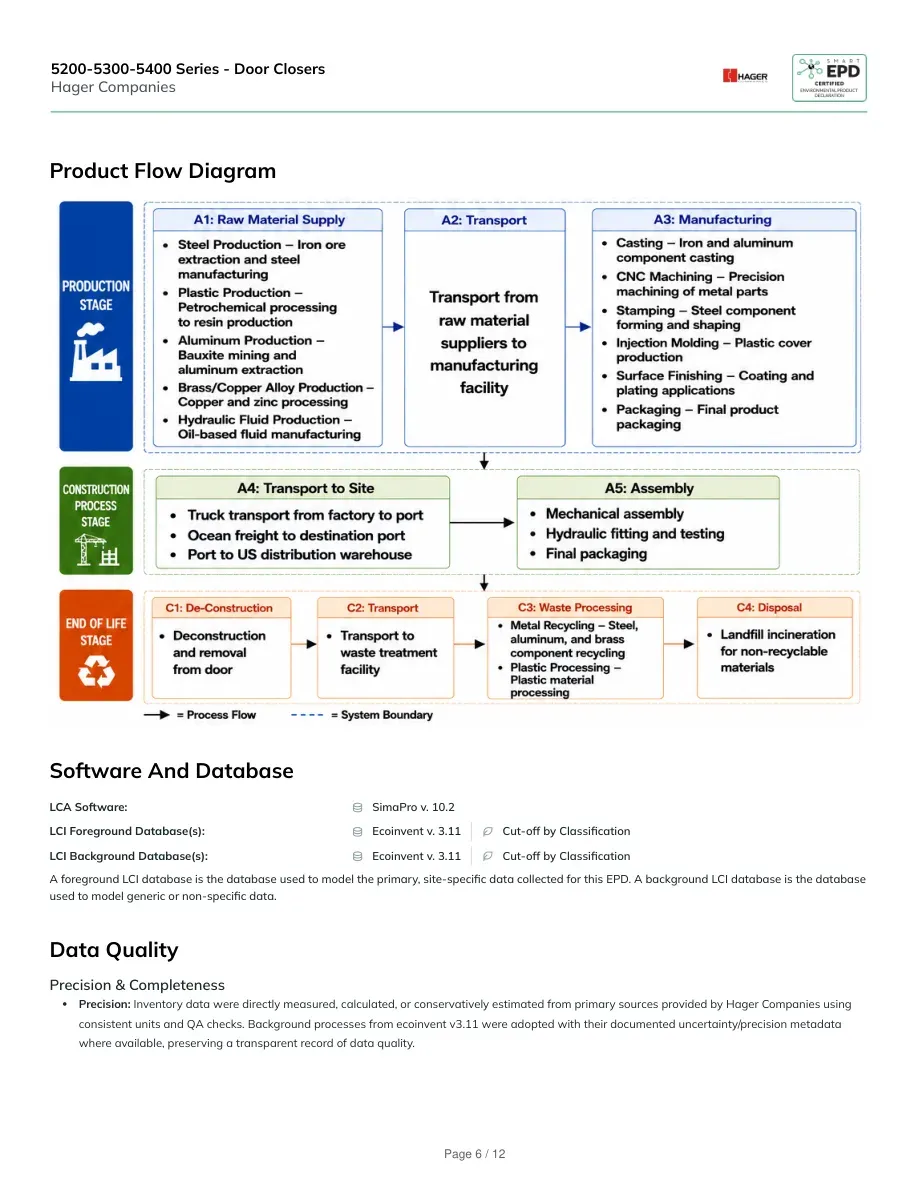
Product Flow DiagramSoftware And DatabaseLCA Software:SimaPro v. 10.2LCI Foreground Database(s):Ecoinvent v. 3.11Cut-off by ClassificationLCI Background Database(s):Ecoinvent v. 3.11Cut-off by ClassificationA foreground LCI database is the database used to model the primary, site-specific data collected for this EPD. A background LCI database is the databaseused to model generic or non-specific data.Data QualityPrecision & CompletenessPrecision: Inventory data were directly measured, calculated, or conservatively estimated from primary sources provided by Hager Companies usingconsistent units and QA checks. Background processes from ecoinvent v3.11 were adopted with their documented uncertainty/precision metadatawhere available, preserving a transparent record of data quality.5200-5300-5400 Series - Door ClosersHager CompaniesPage 6 / 12
Completeness: The product system's mass balance and inventory completeness were thoroughly checked. Some exclusions were made in line with thePCR requirements, such as personnel impacts, R&D activities, business travel, and point-of-sale infrastructure. However, no data were intentionallyomitted.Consistency and ReproducibilityConsistency: Primary data for all modules were consistently gathered from Hager Companies’ manufacturing operations, aiming at the highest level ofdetail possible. Background processes were modeled mainly with the ecoinvent database. The same allocation rules, cut-off criteria, and impactassessment methods were applied throughout, ensuring methodological coherence and consistent data quality across the entire LCA model.Reproducibility: This study ensures reproducibility by providing comprehensive disclosure of input–output data, dataset choices, and modelingapproaches. A knowledgeable third party should be able to approximate the results using the same data and modeling methods.RepresentativenessTemporal: Primary data were collected for a 12-month period representing the most recent full year of production available from Hager Companies toensure temporal representativeness. Secondary data from the ecoinvent v3.11 database are typically representative of recent years.Geographical: Primary data represent Hager Companies’ production facilities in China and Taiwan. Where applicable, differences in electric grid mixwere considered using appropriate secondary data. The use of country-specific data ensures high geographical representativeness, and proxy datawere only used when country-specific data were unavailable.Technological: Both primary and secondary data were tailored to the specific technologies used by Hager Companies, ensuring high technologicalrepresentativeness.Life Cycle Module DescriptionModules A1–A3: The LCA model covers the manufacture of raw materials and components for Hager Companies products (A1) which are then transportedto Hager Companies facilities by truck (A2). The manufacturing stage (A3) begins with receipt of these materials, which are cast, machined, stamped, andassembled into finished door closers. When required, additional components such as springs, fasteners, and hydraulic fluid are incorporated duringassembly.Modules A4–A5: Once manufacture is completed, products are shipped to distribution centers and then to the end user by truck and ocean freight (A4). Forinstallation (A5), a 0% material installation loss was assumed. This module includes disposal of that waste and of the product packaging.Modules C1–C4: At end of life (C1–C4), the product is assumed to be collected, and each waste stream (e.g., steel, aluminum, brass, plastic) is handledseparately—landfilled, recycled, or incinerated with energy recovery.LCA DiscussionAllocation ProcedureAllocation of co-products was avoided wherever possible in accordance with ISO 14044:2006, Section 4.3. In cases where allocation could not be avoided,allocation was applied using a mass-based approach consistent with UL PCR Part A requirements. Energy consumption at Hager Companies’manufacturing facilities was allocated to the studied products based on production volume. Inputs and outputs, including emissions to air, water, and soil,were accounted for in accordance with ISO 21930 and UL PCR guidance, primarily arising from upstream processes and energy use. Solid waste generationwas estimated based on material losses and packaging flows, and waste treatment processes were modeled in accordance with the polluter pays principle,with no allocation of environmental credits within the system boundary.Cut-off ProcedureThe system boundary was defined in accordance with ISO 21930 and UL PCR Part A requirements, based on relevance to the goal and scope of the study.For Modules A1–A3, all relevant material and energy inputs, as well as associated outputs, were included in the model to the extent that data were available5200-5300-5400 Series - Door ClosersHager CompaniesPage 7 / 12
and met the defined data quality criteria. No material or energy flows known to be significant were intentionally excluded, and cut-off criteria were appliedconsistently in accordance with UL PCR guidance.Renewable ElectricityEnergy Attribute Certificates (EACs) such asRenewable Energy Certificates (RECs) or PowerPurchase Agreements (PPAs) are included in thebaseline reported results:NoScenariosTransport to the building/construction site (A4)A4 ModuleFuel Type:DieselVehicle Type:Truck and TrailerTransport Distance:19860 kmCapacity Utilization:33 %Packaging Mass:0.1999 kgWeight of products transported:3.14 kgCapacity utilization volume factor:1Assumptions for scenario development:Transport distance includes finished product to distribution center and distribution center to pointof sale.Installation in to the building/construction site (A5)A5 ModuleMass of Packaging Waste Specified by Type:0.1999 kgBiogenic Carbon Contained in Packaging (kg C):0.09368 kgAssumptions for scenario development:Installation impacts limited to packaging waste disposal, no significant material losses assumed.End of Life (C1 - C4)C1 - C4 ModulesCollection ProcessCollected with Mixed Construction Waste:2.94 kgRecoveryRecycling:2.15 kgLandfill:0.7808 kgIncineration:0.008873 kgAssumptions for scenario development:Disposal/Recycling rates as per Part A PCR5200-5300-5400 Series - Door ClosersHager CompaniesPage 8 / 12
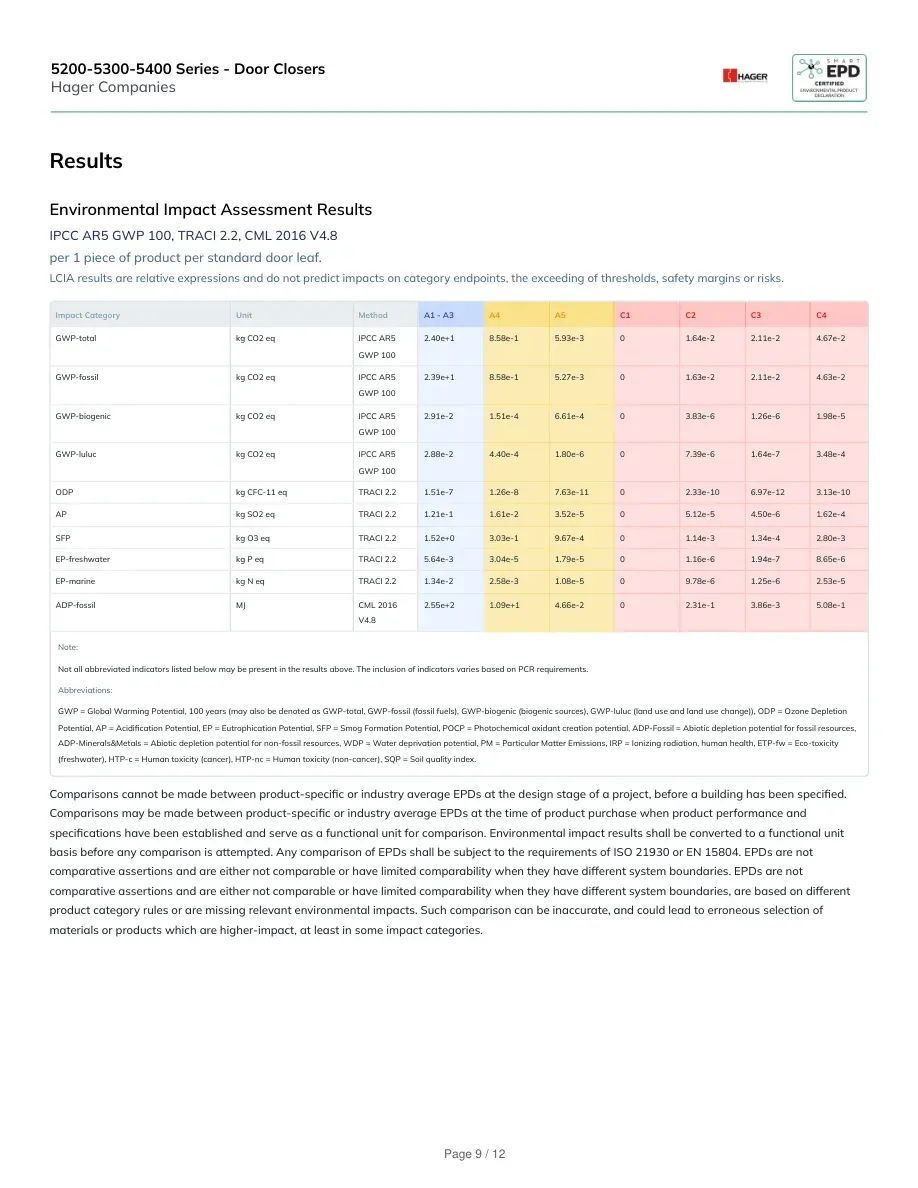
ResultsEnvironmental Impact Assessment ResultsIPCC AR5 GWP 100, TRACI 2.2, CML 2016 V4.8per 1 piece of product per standard door leaf.LCIA results are relative expressions and do not predict impacts on category endpoints, the exceeding of thresholds, safety margins or risks.Impact CategoryUnitMethodA1 - A3A4A5C1C2C3C4GWP-totalkg CO2 eqIPCC AR5GWP 1002.40e+18.58e-15.93e-301.64e-22.11e-24.67e-2GWP-fossilkg CO2 eqIPCC AR5GWP 1002.39e+18.58e-15.27e-301.63e-22.11e-24.63e-2GWP-biogenickg CO2 eqIPCC AR5GWP 1002.91e-21.51e-46.61e-403.83e-61.26e-61.98e-5GWP-luluckg CO2 eqIPCC AR5GWP 1002.88e-24.40e-41.80e-607.39e-61.64e-73.48e-4ODPkg CFC-11 eqTRACI 2.21.51e-71.26e-87.63e-1102.33e-106.97e-123.13e-10APkg SO2 eqTRACI 2.21.21e-11.61e-23.52e-505.12e-54.50e-61.62e-4SFPkg O3 eqTRACI 2.21.52e+03.03e-19.67e-401.14e-31.34e-42.80e-3EP-freshwaterkg P eqTRACI 2.25.64e-33.04e-51.79e-501.16e-61.94e-78.65e-6EP-marinekg N eqTRACI 2.21.34e-22.58e-31.08e-509.78e-61.25e-62.53e-5ADP-fossilMJCML 2016V4.82.55e+21.09e+14.66e-202.31e-13.86e-35.08e-1Note:Not all abbreviated indicators listed below may be present in the results above. The inclusion of indicators varies based on PCR requirements.Abbreviations:GWP = Global Warming Potential, 100 years (may also be denoted as GWP-total, GWP-fossil (fossil fuels), GWP-biogenic (biogenic sources), GWP-luluc (land use and land use change)), ODP = Ozone DepletionPotential, AP = Acidification Potential, EP = Eutrophication Potential, SFP = Smog Formation Potential, POCP = Photochemical oxidant creation potential, ADP-Fossil = Abiotic depletion potential for fossil resources,ADP-Minerals&Metals = Abiotic depletion potential for non-fossil resources, WDP = Water deprivation potential, PM = Particular Matter Emissions, IRP = Ionizing radiation, human health, ETP-fw = Eco-toxicity(freshwater), HTP-c = Human toxicity (cancer), HTP-nc = Human toxicity (non-cancer), SQP = Soil quality index.Comparisons cannot be made between product-specific or industry average EPDs at the design stage of a project, before a building has been specified.Comparisons may be made between product-specific or industry average EPDs at the time of product purchase when product performance andspecifications have been established and serve as a functional unit for comparison. Environmental impact results shall be converted to a functional unitbasis before any comparison is attempted. Any comparison of EPDs shall be subject to the requirements of ISO 21930 or EN 15804. EPDs are notcomparative assertions and are either not comparable or have limited comparability when they have different system boundaries. EPDs are notcomparative assertions and are either not comparable or have limited comparability when they have different system boundaries, are based on differentproduct category rules or are missing relevant environmental impacts. Such comparison can be inaccurate, and could lead to erroneous selection ofmaterials or products which are higher-impact, at least in some impact categories.5200-5300-5400 Series - Door ClosersHager CompaniesPage 9 / 12
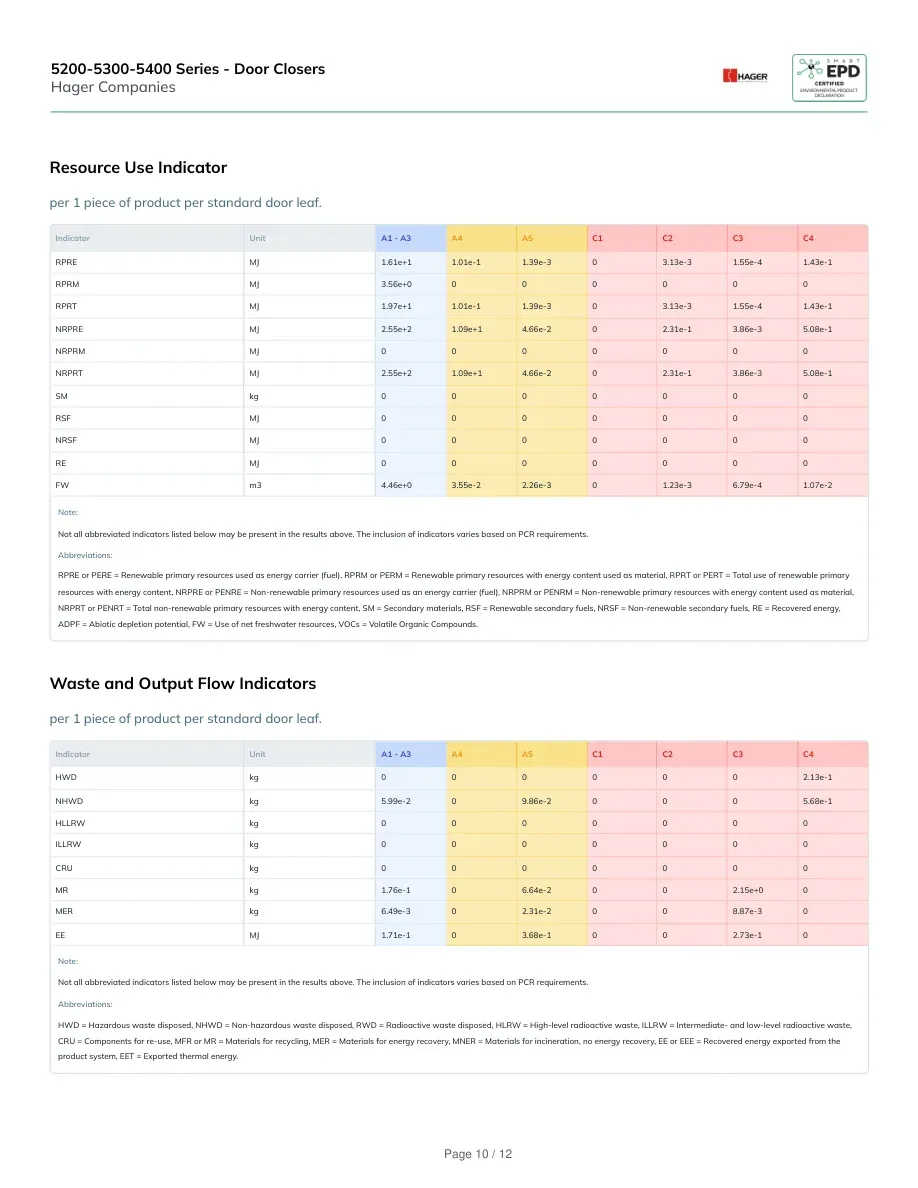
Resource Use Indicatorper 1 piece of product per standard door leaf.IndicatorUnitA1 - A3A4A5C1C2C3C4RPREMJ1.61e+11.01e-11.39e-303.13e-31.55e-41.43e-1RPRMMJ3.56e+0000000RPRTMJ1.97e+11.01e-11.39e-303.13e-31.55e-41.43e-1NRPREMJ2.55e+21.09e+14.66e-202.31e-13.86e-35.08e-1NRPRMMJ0000000NRPRTMJ2.55e+21.09e+14.66e-202.31e-13.86e-35.08e-1SMkg0000000RSFMJ0000000NRSFMJ0000000REMJ0000000FWm34.46e+03.55e-22.26e-301.23e-36.79e-41.07e-2Note:Not all abbreviated indicators listed below may be present in the results above. The inclusion of indicators varies based on PCR requirements.Abbreviations:RPRE or PERE = Renewable primary resources used as energy carrier (fuel), RPRM or PERM = Renewable primary resources with energy content used as material, RPRT or PERT = Total use of renewable primaryresources with energy content, NRPRE or PENRE = Non-renewable primary resources used as an energy carrier (fuel), NRPRM or PENRM = Non-renewable primary resources with energy content used as material,NRPRT or PENRT = Total non-renewable primary resources with energy content, SM = Secondary materials, RSF = Renewable secondary fuels, NRSF = Non-renewable secondary fuels, RE = Recovered energy,ADPF = Abiotic depletion potential, FW = Use of net freshwater resources, VOCs = Volatile Organic Compounds.Waste and Output Flow Indicatorsper 1 piece of product per standard door leaf.IndicatorUnitA1 - A3A4A5C1C2C3C4HWDkg0000002.13e-1NHWDkg5.99e-209.86e-20005.68e-1HLLRWkg0000000ILLRWkg0000000CRUkg0000000MRkg1.76e-106.64e-2002.15e+00MERkg6.49e-302.31e-2008.87e-30EEMJ1.71e-103.68e-1002.73e-10Note:Not all abbreviated indicators listed below may be present in the results above. The inclusion of indicators varies based on PCR requirements.Abbreviations:HWD = Hazardous waste disposed, NHWD = Non-hazardous waste disposed, RWD = Radioactive waste disposed, HLRW = High-level radioactive waste, ILLRW = Intermediate- and low-level radioactive waste,CRU = Components for re-use, MFR or MR = Materials for recycling, MER = Materials for energy recovery, MNER = Materials for incineration, no energy recovery, EE or EEE = Recovered energy exported from theproduct system, EET = Exported thermal energy.5200-5300-5400 Series - Door ClosersHager CompaniesPage 10 / 12
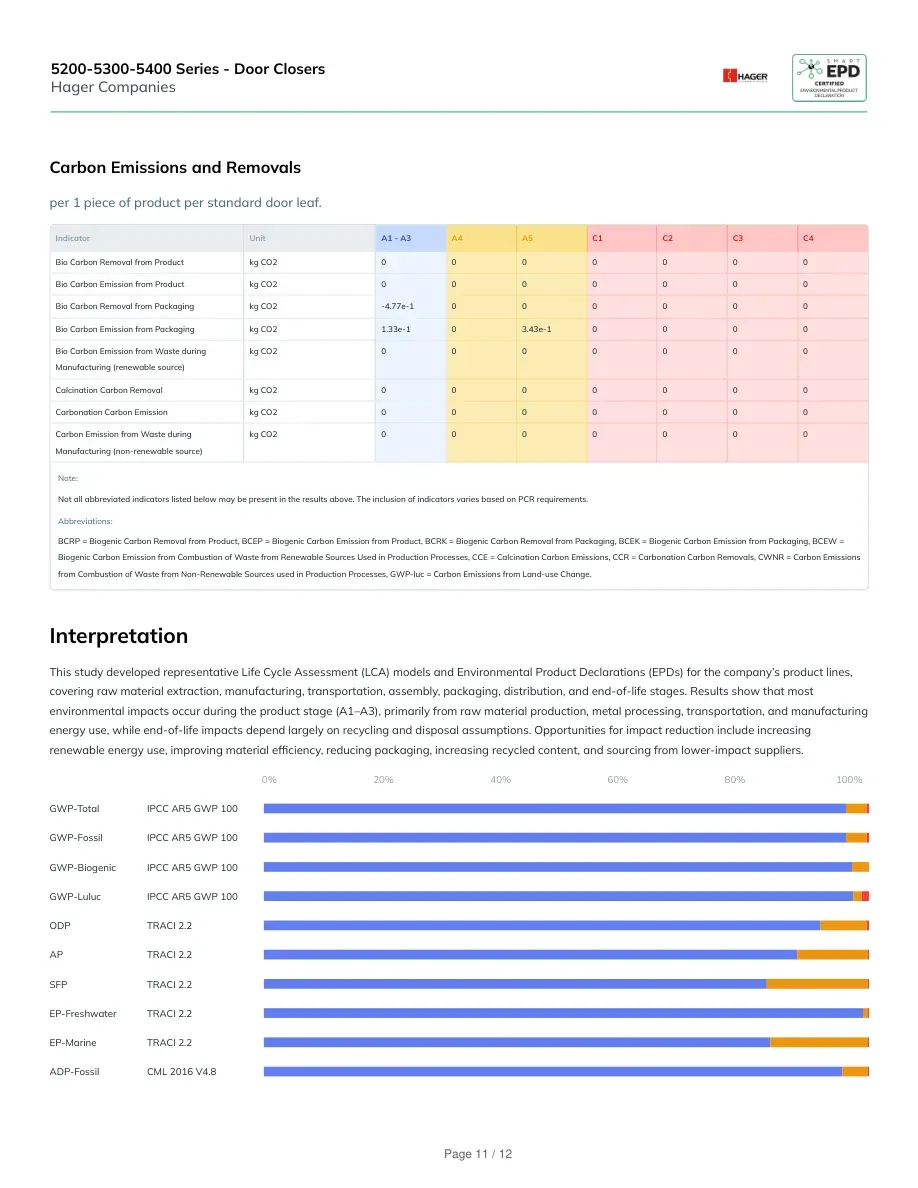
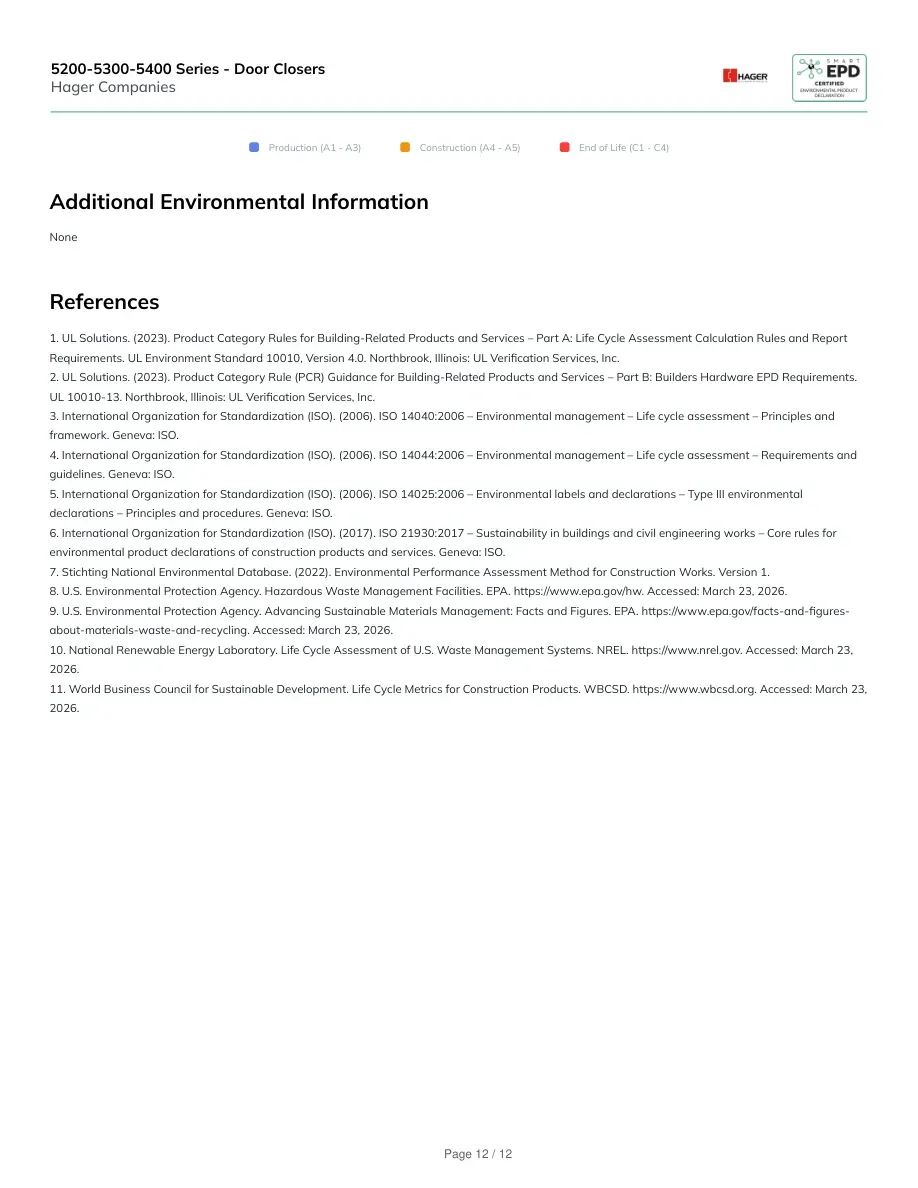
Carbon Emissions and Removalsper 1 piece of product per standard door leaf.IndicatorUnitA1 - A3A4A5C1C2C3C4Bio Carbon Removal from Productkg CO20000000Bio Carbon Emission from Productkg CO20000000Bio Carbon Removal from Packagingkg CO2-4.77e-1000000Bio Carbon Emission from Packagingkg CO21.33e-103.43e-10000Bio Carbon Emission from Waste duringManufacturing (renewable source)kg CO20000000Calcination Carbon Removalkg CO20000000Carbonation Carbon Emissionkg CO20000000Carbon Emission from Waste duringManufacturing (non-renewable source)kg CO20000000Note:Not all abbreviated indicators listed below may be present in the results above. The inclusion of indicators varies based on PCR requirements.Abbreviations:BCRP = Biogenic Carbon Removal from Product, BCEP = Biogenic Carbon Emission from Product, BCRK = Biogenic Carbon Removal from Packaging, BCEK = Biogenic Carbon Emission from Packaging, BCEW =Biogenic Carbon Emission from Combustion of Waste from Renewable Sources Used in Production Processes, CCE = Calcination Carbon Emissions, CCR = Carbonation Carbon Removals, CWNR = Carbon Emissionsfrom Combustion of Waste from Non-Renewable Sources used in Production Processes, GWP-luc = Carbon Emissions from Land-use Change.InterpretationThis study developed representative Life Cycle Assessment (LCA) models and Environmental Product Declarations (EPDs) for the company’s product lines,covering raw material extraction, manufacturing, transportation, assembly, packaging, distribution, and end-of-life stages. Results show that mostenvironmental impacts occur during the product stage (A1–A3), primarily from raw material production, metal processing, transportation, and manufacturingenergy use, while end-of-life impacts depend largely on recycling and disposal assumptions. Opportunities for impact reduction include increasingrenewable energy use, improving material efficiency, reducing packaging, increasing recycled content, and sourcing from lower-impact suppliers.0%20%40%60%80%100%GWP-TotalIPCC AR5 GWP 100GWP-FossilIPCC AR5 GWP 100GWP-BiogenicIPCC AR5 GWP 100GWP-LulucIPCC AR5 GWP 100ODPTRACI 2.2APTRACI 2.2SFPTRACI 2.2EP-FreshwaterTRACI 2.2EP-MarineTRACI 2.2ADP-FossilCML 2016 V4.85200-5300-5400 Series - Door ClosersHager CompaniesPage 11 / 12
Production (A1 - A3)Construction (A4 - A5)End of Life (C1 - C4)Additional Environmental InformationNoneReferences1. UL Solutions. (2023). Product Category Rules for Building-Related Products and Services – Part A: Life Cycle Assessment Calculation Rules and ReportRequirements. UL Environment Standard 10010, Version 4.0. Northbrook, Illinois: UL Verification Services, Inc.2. UL Solutions. (2023). Product Category Rule (PCR) Guidance for Building-Related Products and Services – Part B: Builders Hardware EPD Requirements.UL 10010-13. Northbrook, Illinois: UL Verification Services, Inc.3. International Organization for Standardization (ISO). (2006). ISO 14040:2006 – Environmental management – Life cycle assessment – Principles andframework. Geneva: ISO.4. International Organization for Standardization (ISO). (2006). ISO 14044:2006 – Environmental management – Life cycle assessment – Requirements andguidelines. Geneva: ISO.5. International Organization for Standardization (ISO). (2006). ISO 14025:2006 – Environmental labels and declarations – Type III environmentaldeclarations – Principles and procedures. Geneva: ISO.6. International Organization for Standardization (ISO). (2017). ISO 21930:2017 – Sustainability in buildings and civil engineering works – Core rules forenvironmental product declarations of construction products and services. Geneva: ISO.7. Stichting National Environmental Database. (2022). Environmental Performance Assessment Method for Construction Works. Version 1.8. U.S. Environmental Protection Agency. Hazardous Waste Management Facilities. EPA. https://www.epa.gov/hw. Accessed: March 23, 2026.9. U.S. Environmental Protection Agency. Advancing Sustainable Materials Management: Facts and Figures. EPA. https://www.epa.gov/facts-and-figures-about-materials-waste-and-recycling. Accessed: March 23, 2026.10. National Renewable Energy Laboratory. Life Cycle Assessment of U.S. Waste Management Systems. NREL. https://www.nrel.gov. Accessed: March 23,2026.11. World Business Council for Sustainable Development. Life Cycle Metrics for Construction Products. WBCSD. https://www.wbcsd.org. Accessed: March 23,2026.5200-5300-5400 Series - Door ClosersHager CompaniesPage 12 / 12
